Shopping for a dishwasher isn’t like picking out a new toaster. You’re looking at a 10–15 year commitment, a $400–$1,500 investment, and a major piece of kitchen infrastructure. Buy the wrong model, and you’ll spend the next decade rewashing plates by hand, calling repair techs, or dealing with leaks that warp your hardwood floors. Some brands consistently underdeliver on durability, cleaning performance, and parts availability, issues that only show up after the return window closes. This guide identifies which dishwasher manufacturers to steer clear of in 2026 and what warning signs to watch for before you swipe your card.
Table of Contents
ToggleKey Takeaways
- Dishwasher brands to avoid include budget models from Frigidaire, Magic Chef, and Haier, which suffer from control board failures, poor drainage, and limited parts availability within 2–3 years of purchase.
- Mid-range dishwasher brands like Whirlpool, Maytag, and LG offer inconsistent quality control and fail to justify their $500–$800 price point compared to more reliable competitors.
- Key warning signs when shopping include plastic tub construction above $400, proprietary parts with poor availability, overly complicated touchscreen controls, and noise levels exceeding 50 dBA.
- Reliable dishwasher investments prioritize stainless steel construction, soil sensor technology, hard-food disposers, and 5+ year warranties—proven features that extend lifespan to 15 years or more.
- Bosch and Miele consistently rank highest for reliability and parts availability, while KitchenAid upper-tier models offer strong cleaning performance with thoughtful design choices worth the investment.
Why Some Dishwasher Brands Fall Short of Expectations
Not all dishwasher failures come from user error or bad luck. Certain manufacturers cut corners in ways that don’t show up on the showroom floor but become obvious six months into ownership.
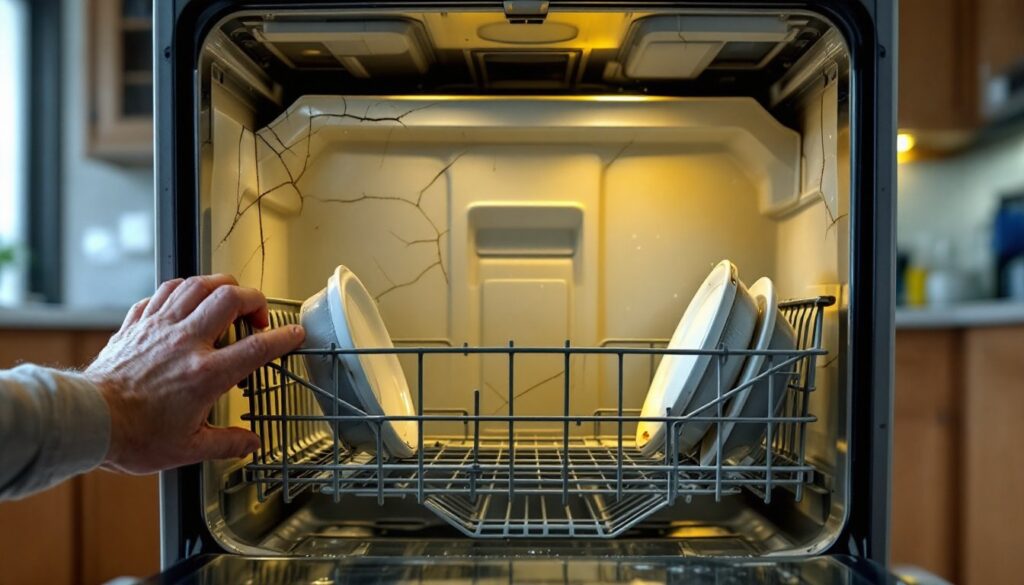
Poor component quality is the biggest culprit. Cheaper brands often use plastic tub interiors instead of stainless steel, leading to warping, staining, and cracking. Plastic pump housings fail faster than metal equivalents, especially in hard-water areas. Flimsy racks with thin tine wires bend under the weight of cast-iron skillets or heavy ceramic dishes.
Inadequate testing cycles during manufacturing mean some models ship with control boards that fail early, door latches that don’t seal properly, or spray arms that clog within months. When a brand prioritizes price point over engineering, those compromises compound over time.
Limited parts availability becomes a nightmare when something breaks. Discount brands often discontinue models within two years, making replacement parts scarce or forcing owners to jury-rig repairs. Premium brands typically stock parts for 7–10 years minimum.
Weak customer support leaves buyers stranded. Some manufacturers outsource warranty service to third-party networks with slow response times and undertrained techs who struggle with diagnostics. When your kitchen floods at 9 p.m. on a Saturday, a 72-hour callback window isn’t good enough.
Budget Brands with Persistent Reliability Issues
The sub-$400 dishwasher category tempts buyers with low upfront costs, but many models in this range have earned reputations for chronic problems.
Frigidaire entry-level models (particularly the FFCD series) suffer from recurring control board failures and drainage issues. Owners report error codes within the first year and repair costs that approach half the purchase price. The brand’s customer service response times lag behind competitors.
Magic Chef dishwashers, often sold through big-box retailers, use outdated spray arm designs that leave entire sections of the rack uncleaned. The plastic interiors crack easily, and replacement parts are notoriously hard to source after the first two years.
Haier models sold under various rebadged names (including some GE Appliances budget lines) have documented issues with door latch mechanisms and leaking seals. Independent appliance techs note that the internal hose connections use compression fittings that fail more frequently than crimped or welded joints.
Common Problems with Low-End Models
These issues show up across multiple budget brands with surprising consistency:
- Inadequate insulation: Noise levels often exceed 55 dBA, making conversation in the kitchen impossible during operation. Look for models rated below 48 dBA if your kitchen opens to living spaces.
- Weak wash motors: Budget pumps struggle with baked-on food, forcing users to pre-rinse heavily (which defeats the purpose of owning a dishwasher).
- Flimsy door springs: Over-tensioned or under-engineered springs cause doors to drop open suddenly or refuse to stay closed, a safety hazard if you have small children.
- Non-serviceable components: Some manufacturers glue or rivet assemblies that should be bolted, making repairs impossible without replacing entire subsystems.
- Short warranty periods: One-year parts-and-labor warranties signal a manufacturer’s lack of confidence in their product’s longevity. Compare this to brands offering 3–5 year coverage on major components.
Budget models also skip features that extend lifespan, like self-cleaning filters, stainless steel tubs, and soil sensors that adjust cycle intensity. These aren’t luxury extras, they’re engineering choices that determine whether your dishwasher lasts 5 years or 15.
Mid-Range Brands That Don’t Deliver on Value
The $500–$800 price bracket is where expectations rise sharply. Buyers in this range expect reliable performance, reasonable features, and decent build quality. Some brands charge mid-range prices while delivering budget-level engineering.
Whirlpool mid-tier models (particularly the WDF and WDT series) have inconsistent quality control. Some units run flawlessly for years: others develop control panel failures, heating element burnouts, or rack coating that peels within 18 months. The variability suggests manufacturing tolerances aren’t tight enough.
Maytag dishwashers, even though the brand’s reputation in other appliance categories, lag in cleaning performance tests conducted by major appliance reviewers. Their hard-food disposers clog more frequently than competitors at similar price points, and the proprietary filter design makes cleaning awkward.
Amana models share components with Whirlpool (same parent company) but often use even cheaper materials. The stainless steel tubs are thinner gauge, racks feel flimsy, and door seals deteriorate faster.
LG mid-range units confuse buyers with overcomplicated control interfaces and Wi-Fi connectivity that adds cost without improving wash quality. More importantly, LG’s direct-drive motors, while quiet, have documented longevity issues between years 3–6 of ownership. Replacement costs often exceed $400 before labor.
These brands aren’t universally terrible, but they occupy an uncomfortable middle ground: too expensive to justify as disposable, not durable enough to merit the investment. For $100–$200 more, buyers can typically step up to brands with better track records. For $200 less, budget models offer similar performance with appropriately lower expectations.
Red Flags to Watch for When Shopping for a Dishwasher
Certain warning signs predict trouble before you ever run a load. Spotting these during research can save you from a costly mistake.
Plastic tub construction in models over $400 is an immediate red flag. Stainless steel should be standard in this price range. Plastic tubs retain odors, stain easily, and crack under thermal stress.
Proprietary parts and uncommon brands create long-term headaches. If you can’t easily find replacement racks, spray arms, or filters through multiple suppliers, walk away. Check parts availability before buying, not after something breaks.
Models with frequent redesigns often indicate a manufacturer is chasing trends rather than refining engineering. When searching for reviews from technology and product testing sites, be wary of models with less than two years of user feedback.
Overly complicated control panels with touchscreens, excessive cycle options, and app connectivity often fail earlier than simple mechanical controls. Every additional electronic component is another potential failure point.
No NSF certification means the unit hasn’t been independently tested for sanitation performance. This is non-negotiable if you’re serious about food safety.
Rebadged or store-brand models sold exclusively through single retailers often lack the support infrastructure of nationally distributed brands. Kenmore, for example, sources from multiple manufacturers, making warranty service inconsistent.
Suspiciously low prices on otherwise premium-looking models usually mean refurbished units, discontinued inventory, or cosmetic defects. Legitimate floor model discounts are fine, but verify what you’re actually buying.
Minimal insulation shows up as high dBA ratings (anything over 50 dBA is noticeably loud). Cheap insulation also means higher energy use, since the water heater works harder to maintain temperature.
What to Look for in a Reliable Dishwasher Instead
Once you’ve identified what to avoid, focus on brands and features with proven track records.
Bosch consistently ranks highest for reliability across multiple price points. Their 300 and 500 series models use solid engineering, run quietly (44–46 dBA), and have excellent parts availability. The concealed heating element prevents melted plastics, and their rack designs accommodate awkward items better than most competitors.
Miele represents the premium tier, with commercial-grade components and 20-year expected lifespans. They’re expensive ($1,200–$2,500), but cost-per-year often beats cheaper units that need replacement every 7–8 years.
KitchenAid upper-tier models (particularly the KDTM series) deliver strong cleaning performance and feature thoughtful design choices like third racks and adjustable tines. They share some components with Whirlpool but use better materials in critical areas.
Key features worth paying for:
- Stainless steel tub and door liner: Essential for durability and heat retention.
- Soil sensor technology: Adjusts cycle length and water usage based on load dirtiness, saving energy and improving results.
- Hard-food disposer: Grinds up particles instead of relying on filters alone. Reduces maintenance and prevents redeposit.
- Adjustable racks: Upper racks that raise/lower and fold-down tines handle everything from sheet pans to wine glasses.
- Delay start with leak protection: Lets you run cycles during off-peak electric rates while the auto-shutoff system protects against overflow.
- Five-year or longer warranty: Manufacturers confident in their engineering back it up with coverage.
When shopping, prioritize simplicity and build quality over flashy features. The best dishwasher is one you forget about because it works reliably every time. Check reviews from kitchen-focused publications that focus on long-term performance, not just initial impressions.
Buy from retailers with strong return policies, at least 30 days, ideally 90. Run multiple test loads during this window with different dish types and soil levels. If anything feels off (excessive noise, poor drying, spots on glassware), return it immediately.
Conclusion
A dishwasher purchase shouldn’t feel like a gamble. Avoid brands with documented reliability issues, especially in the budget and mid-range categories where quality control lapses are most common. Focus on manufacturers with strong engineering, readily available parts, and responsive customer support. The right dishwasher pays for itself through years of reliable service, the wrong one costs you time, money, and frustration long after installation.