A custom range hood does more than vent smoke and grease, it anchors your kitchen’s visual identity. Off-the-shelf models often fall short on fit, function, or style, leaving homeowners with a compromise between ventilation performance and design intent. Custom hoods solve this by matching exact dimensions, integrating seamlessly with cabinetry, and offering finishes that align with the rest of the space. Whether someone’s renovating a historic home or building a modern showpiece, a custom hood delivers the control and presence that stock options can’t.
Table of Contents
ToggleKey Takeaways
- A custom range hood provides dimensional precision and seamless design integration that off-the-shelf models cannot match, making it ideal for non-standard cooktops, ceiling heights, and architectural continuity.
- Custom hood styles—from traditional wood with corbel details to modern stainless steel with remote blowers—must match your kitchen’s design language and cooking habits, whether it’s occasional sautéing or daily high-heat cooking.
- Proper CFM sizing is critical: gas cooktops require 100 CFM per 10,000 BTU, while electric cooktops need about 150 CFM per linear foot, with the hood positioned 24 to 30 inches above the cooktop for optimal capture.
- DIY installation suits intermediate builders for straightforward wall-mounted hoods with accessible framing, but structural modifications, complex ductwork, or island installations should be handled by licensed professionals.
- Realistic budgeting for custom range hood projects ranges from $1,500 to $3,000 for DIY wood builds with quality liners, to $3,000 to $7,000+ for professionally designed metal hoods, with high-end custom finishes exceeding $10,000.
What Is a Custom Range Hood and Why Choose One?
A custom range hood is a ventilation unit designed and fabricated to specific dimensions, materials, and aesthetic preferences rather than selected from a manufacturer’s catalog. The custom approach accommodates non-standard cooktop widths, ceiling heights, and integration with surrounding millwork.
Stock hoods typically come in 30-, 36-, or 48-inch widths with fixed CFM ratings and limited finish options. Custom builds can span any width, incorporate varied duct routing, and feature materials like reclaimed wood, hand-hammered copper, or powder-coated steel.
Homeowners choose custom hoods for several practical reasons. First, dimensional precision, when a cooktop sits in an alcove or beneath a beam, standard sizing often leaves gaps or requires filler panels. Second, performance tuning, custom fabricators can spec blowers to match cooking habits, whether that’s occasional sautéing or daily high-heat wok cooking. Third, architectural continuity, a hood can be designed to match existing trim profiles, cabinet door styles, or exposed structural elements.
Custom hoods also address functional issues that plague off-the-shelf models: insufficient capture area for wide ranges, inadequate clearance for tall cooks, or poor integration with island layouts. In homes with non-standard ceiling heights or sloped ceilings, custom builds ensure proper capture zone geometry without compromising headroom or sightlines.
Popular Custom Range Hood Styles for Every Kitchen Design
Custom hoods fall into broad style families, each with distinct construction methods and aesthetic signatures. Choosing a style depends on the kitchen’s overall design language, existing materials, and how prominent the hood should be.
Traditional Wood Range Hoods
Wood hoods dominate traditional kitchen designs where warmth and craftsmanship take priority. These typically feature a corbel-supported mantel design with crown molding, raised or recessed panel details, and a finish that matches or complements cabinetry.
Common construction involves a structural frame of 2×4 or 2×6 framing lumber built out from the wall, sheathed with 3/4-inch plywood or MDF, then faced with finish-grade hardwood or painted poplar. The interior houses a ventilation liner, a metal insert containing the blower, lights, and grease filters. Popular liner brands include Vent-A-Hood, Zephyr, and Best, with CFM ratings from 400 to 1200 depending on cooktop output.
Wood hoods work well in farmhouse, cottage, and transitional kitchens. They’re often stained in walnut or oak tones, or painted to match trim. Detailing can include beadboard panels, decorative brackets, or carved corbels. The mantel shelf is typically 10 to 14 inches deep, providing display space for cookbooks or pottery.
One consideration: wood hoods require proper sealing and occasional maintenance. Grease and heat will degrade unprotected wood over time, so multiple coats of polyurethane or conversion varnish are essential.
Modern Metal and Stainless Steel Designs
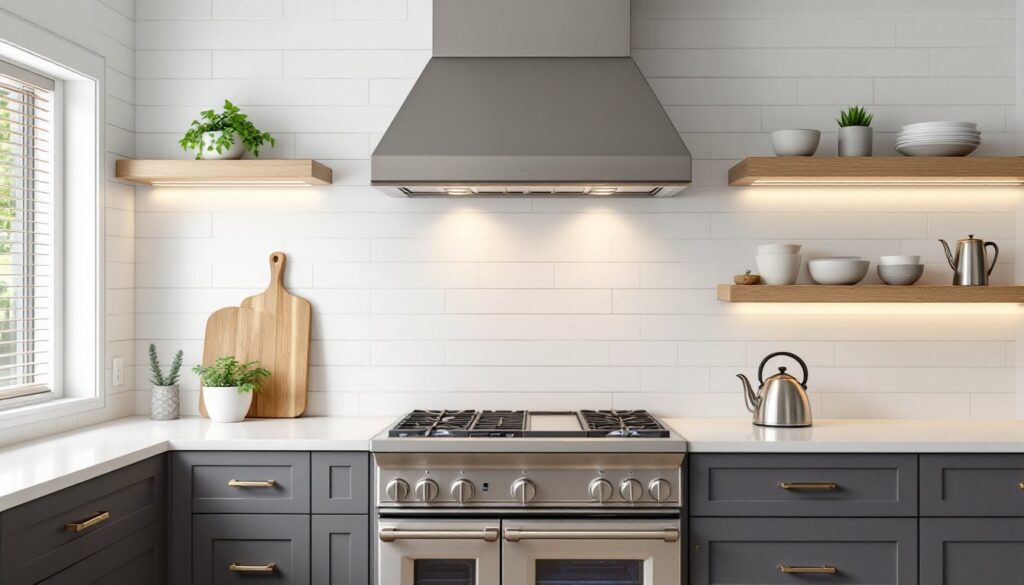
Stainless steel hoods suit contemporary, industrial, and minimalist kitchens. They’re fabricated from 16- to 20-gauge stainless, either brushed, mirror-polished, or powder-coated in matte black or custom colors. Metal hoods can be flush-mounted to drywall, surface-mounted with visible seams, or integrated into a soffit.
Common profiles include straight-sided boxes, tapered pyramids, and curved barrel or arched forms. Welded stainless construction allows for seamless corners and concealed fasteners. Many metal hoods incorporate LED strip lighting inside the canopy for task illumination without visible fixtures.
Metal hoods often use remote blowers, inline or roof-mounted fans that reduce noise and free up space inside the canopy. This setup is quieter and allows for slimmer hood profiles. Ductwork is typically 6- or 8-inch round or rectangular, routed through walls or ceilings to an exterior vent.
For island installations, metal hoods are suspended from the ceiling with threaded rods or cables, anchored to ceiling joists or blocking. Load-bearing capacity matters here, large hoods with integrated blowers can weigh 80 to 150 pounds. Structural attachment points should hit joists or be reinforced with 2×10 blocking between joists.
Other materials gaining traction include blackened steel (oil-rubbed or waxed finishes), zinc (which develops a patina over time), and copper (available in natural, aged, or hammered finishes). Each requires specific cleaning and sealing protocols to prevent oxidation or discoloration.
Key Features to Consider When Designing Your Custom Range Hood
Designing a custom hood requires balancing aesthetics, performance, and code compliance. Here are the critical features to spec out before fabrication begins.
CFM and Capture Area: CFM (cubic feet per minute) measures airflow. Gas cooktops require 100 CFM per 10,000 BTU of burner output. A 60,000 BTU range needs at least 600 CFM. Electric cooktops need less, about 150 CFM per linear foot of cooktop width. The hood’s capture area should extend 3 inches beyond each side of the cooking surface and sit 24 to 30 inches above the cooktop for optimal performance.
Ductwork and Ventilation Path: Custom hoods demand thoughtful duct routing. Round metal duct (6- or 8-inch diameter) offers less resistance than rectangular, improving CFM performance. Minimize elbows, each 90-degree turn reduces airflow by roughly 25 CFM. Ductwork should terminate at an exterior wall with a weather cap, not into an attic or crawl space. Check local building codes: some jurisdictions require make-up air systems for hoods over 400 CFM to prevent negative pressure issues.
Interior Liner vs. Insert: Most custom hoods use a ventilation liner, a prefabricated metal box with blower, controls, and filters. Liners simplify installation and ensure UL-listed components. Alternatively, some builders install a separate range hood insert (blower and filters only) and design the surround independently. Remote blowers are ideal for large hoods or noise-sensitive spaces, but require additional ductwork and electrical runs.
Lighting: Integrated LED or halogen lighting provides task illumination. LED strips or puck lights are energy-efficient and generate less heat. Lighting should be rated for enclosed fixtures and controlled by a separate switch or integrated into the hood’s control panel.
Material Finishes: Select finishes based on cleaning requirements. Brushed stainless hides fingerprints better than polished. Wood finishes need grease-resistant topcoats. Powder-coated metals resist scratching but can chip if struck. For heavy cooking, avoid porous materials like unsealed copper or raw wood near the cooking surface.
Structural Support: Wall-mounted hoods anchor to wall studs with lag bolts or structural screws. Island hoods require ceiling blocking between joists or mounting to a steel support frame. Always locate studs or joists with a stud finder or by referencing ceiling joist direction. If joists run parallel to the hood, install perpendicular blocking to distribute the load.
DIY vs. Professional Installation: Which Path Is Right for You?
Custom range hood installation straddles carpentry, electrical, and HVAC work. Deciding whether to DIY or hire out depends on the project’s complexity and the homeowner’s skill set.
DIY-Friendly Scenarios: Installing a prefabricated liner into a wood surround built on-site is manageable for intermediate DIYers. If wall framing is accessible, ductwork is a straight shot to an exterior wall, and electrical is already roughed in, the project involves basic carpentry, drywall, and finish work. Tools needed include a circular saw or miter saw, drill/driver, level, stud finder, and reciprocating saw for ductwork penetrations.
Key steps: frame out the hood box with 2x4s, sheath with plywood, install the liner per manufacturer specs, run ductwork (use metal duct tape, not cloth), connect power (see electrical notes below), then apply trim and finish. Surface-mounted liners simplify the process, secure the liner to studs, attach the decorative surround, and finish seams.
When to Hire a Pro: Complex installs requiring structural modifications, soffit removal, or custom metal fabrication warrant professional help. If ductwork must route through multiple floor levels, across long horizontal runs, or requires a roof jack install, an HVAC contractor ensures proper slope, sealing, and weatherproofing.
Electrical Considerations: Range hoods typically require a dedicated 120V circuit. If wiring isn’t present, an electrician should run a new circuit from the panel. Some high-CFM blowers require 20-amp circuits. Homeowners comfortable with basic wiring can handle the final connections, black (hot) to black, white (neutral) to white, ground to green or bare copper, but the circuit itself should be installed by a licensed electrician or inspected per local code. Never tap into an existing kitchen circuit that already serves outlets or appliances.
Permits and Inspections: Most jurisdictions require permits for new ductwork, electrical circuits, or structural modifications. Wall-mounted hoods that don’t alter framing may not need a permit, but check with the local building department. Island hoods often require structural engineering approval if ceiling modifications are involved. Skipping permits can complicate home sales or insurance claims.
Budgeting for Your Custom Range Hood Project
Custom range hood costs vary widely based on materials, size, and labor. Here’s a breakdown to set realistic expectations.
Materials: A basic wood hood surround with a mid-grade ventilation liner (400-600 CFM) runs $800 to $1,500 in materials. This includes framing lumber, plywood, trim, paint or stain, and the liner itself. Higher-end liners with remote blowers or premium finishes (copper, brass) add $500 to $2,000. Stainless steel fabrication starts around $1,200 for a simple wall-mount design and climbs to $4,000+ for large island hoods with curved profiles or specialty finishes. Reclaimed wood, hand-forged metal, or architectural details like corbels or carved panels push costs higher.
Labor: Professional installation ranges from $500 to $2,000 depending on complexity. Straightforward wall-mount installs with existing ductwork fall on the lower end. Island hoods requiring ceiling reinforcement, long duct runs, or custom metal work hit the upper range. HVAC contractors charge $75 to $150 per hour: electricians run $80 to $120 per hour. Budget an extra $200 to $500 if structural modifications or permit fees apply.
Total Project Cost: Expect $1,500 to $3,000 for a DIY wood hood with a quality liner, or $3,000 to $7,000+ for a professionally designed and installed custom metal hood. High-end projects with designer finishes, remote blowers, and integrated lighting systems can exceed $10,000.
Cost-Saving Strategies: Source ventilation liners during holiday sales or from online appliance retailers that offer discounts. Use paint-grade poplar or MDF instead of hardwood if the hood will be painted. For metal hoods, request quotes from local fabricators rather than national suppliers, regional shops often offer competitive pricing and faster turnarounds. DIYers can save 40-60% on labor by handling framing, finishing, and trim work themselves while hiring pros only for electrical and complex ductwork.
Cost vs. Value: Custom hoods are a high-impact upgrade. They’re focal points that influence kitchen perceived value, especially in upscale renovations. While unlikely to recoup 100% of cost at resale, they contribute to overall design cohesion and buyer appeal, particularly in homes where kitchen design details matter.