The Bosch 800 Series has held a reputation as a top-shelf dishwasher option for years, but with a price tag that can easily exceed $1,200, sometimes pushing $1,600+ depending on model and finish, homeowners want to know if the performance justifies the cost. This review cuts through the marketing language and examines real-world performance, reliability, and whether the features deliver practical value in daily use. Whether you’re renovating a kitchen or replacing a failing dishwasher, understanding what the 800 Series actually offers (and where it falls short) can help you decide if it’s the right fit for your household.
Table of Contents
ToggleKey Takeaways
- Bosch 800 Series dishwasher reviews consistently highlight exceptional cleaning power with the PrecisionWash™ system, which handles baked-on food and plastics without pre-rinsing.
- Operating costs are minimal at $38–$45 annually thanks to ENERGY STAR® certification and low water consumption of 3 gallons per cycle in Eco mode.
- With noise levels at 42–44 dBA, the Bosch 800 Series delivers near-silent operation comparable to a quiet library, making it ideal for open-concept kitchens.
- The adjustable third rack and RackMatic™ middle rack system provide flexible interior design that accommodates tall stemware, oversized pans, and small containers with ease.
- While the upfront cost exceeds $1,200, owners report 8–10 years of trouble-free service, making the long-term value competitive for households prioritizing durability and efficiency.
What Makes the Bosch 800 Series Stand Out?
The Bosch 800 Series sits in the brand’s mid-to-upper tier, positioned above the 500 and 300 lines but below the premium Benchmark models. The key differentiators include third-rack flexibility, quieter operation (typically rated at 42–44 dBA), and upgraded wash system components like the CrystalDry™ feature, which uses a zeolite mineral drying process to handle plastics better than traditional heated dry cycles.
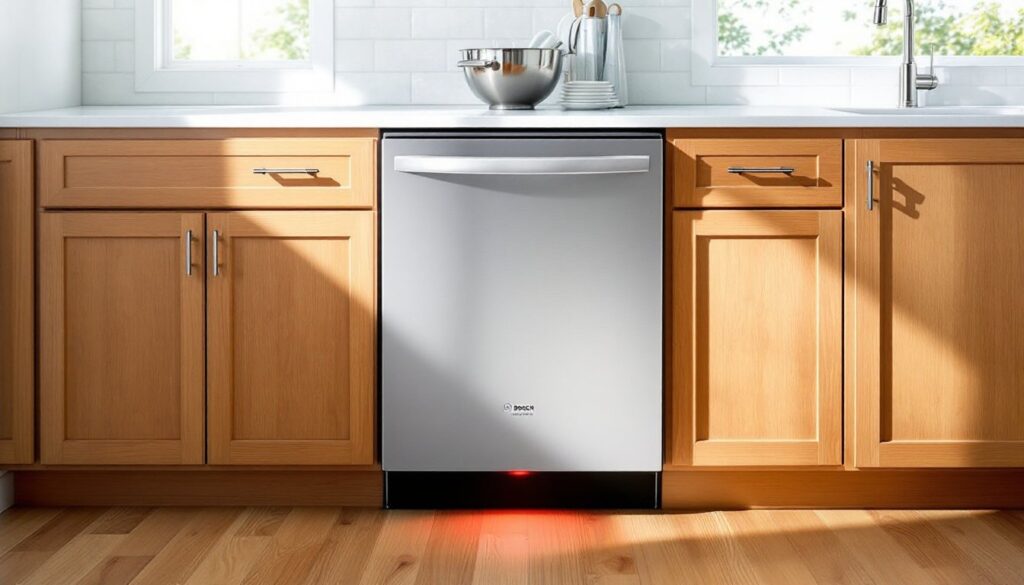
Most 800 Series units are 24 inches wide and designed for standard under-counter installations, though Bosch also offers an 18-inch compact variant. They come in stainless steel, black stainless, and panel-ready options for custom cabinet integration. Controls are top-mounted (hidden when the door closes), which gives a clean front appearance but means you can’t see the cycle status unless you crack the door open, or rely on the InfoLight® floor projection that beams a red light onto your floor during operation and changes to green when done.
The 800 Series includes six to eight wash cycles depending on the model, including Auto, Heavy, Eco, Speed60, Sanitize, and Half Load. The Auto cycle uses sensors to adjust water and heat based on soil level, which is practical for mixed loads. The third rack isn’t just a utensil holder, it’s height-adjustable on some models, allowing you to fit tall stemware below or oversized serving spoons above.
Performance and Cleaning Power
Cleaning performance is where the 800 Series earns its keep. The PrecisionWash™ system uses intelligent sensors and a powerful spray arm configuration to target stuck-on food without pre-rinsing. In independent testing, including evaluations by leading appliance labs, the 800 Series consistently scores high on removing baked-on casserole residue, dried oatmeal, and greasy film from plasticware.
The Sanitize cycle reaches 162°F for the final rinse, hot enough to meet NSF/ANSI Standard 184 for residential dishwashers. This is particularly useful for cutting boards, baby bottles, and cookware that’s handled raw meat. Most cycles run between 2 to 2.5 hours on Auto mode, which is longer than budget dishwashers but typical for premium models that prioritize efficiency and thoroughness over speed.
The Speed60 cycle completes a load in about an hour, though it works best on lightly soiled dishes and uses more water and energy than the Eco mode. For heavily soiled pots and pans, the Heavy cycle extends runtime to around 2 hours and 45 minutes but delivers reliably clean results without manual scrubbing.
One frequent owner note: The Bosch spray arms are height-sensitive. Tall items like mixing bowls or large platters must be positioned so they don’t block the upper spray arm’s rotation. If the arm can’t spin freely, cleaning performance on the top rack drops noticeably.
Noise Level and Kitchen Comfort
Bosch markets the 800 Series heavily on its quiet operation, and this isn’t just hype. At 42–44 dBA, it’s comparable to a whisper or a quiet library. For open-concept kitchens or homes where the dishwasher runs during dinner or evening activities, the difference between a 50+ dBA budget model and the Bosch is immediately noticeable.
The noise reduction comes from multi-layer insulation, a brushless EcoSilence™ motor, and vibration-dampening components. In real-world use, you’ll hear a faint hum if you’re standing directly next to it, but from across the room or in an adjacent living area, it’s nearly silent.
The only audible cue is a soft beep at cycle end, easy to miss if you’re in another room, which is why the InfoLight floor projection becomes a practical feature rather than a gimmick. Some users retrofit third-party cycle indicators if they find the light insufficient, but most appreciate the unobtrusive design.
Compare this to typical builder-grade dishwashers that clock in around 50–55 dBA, and the Bosch feels like a substantial upgrade, especially in homes with hardwood or tile flooring that amplifies appliance noise.
Design, Capacity, and Interior Flexibility
The 800 Series interior is designed around flexibility and capacity. The bottom rack features fold-down tines that adjust to accommodate large pots, sheet pans, and mixing bowls. The middle rack has a RackMatic® system on most models, allowing three height adjustments (up to 2 inches of lift) without removing the rack, handy when you need extra vertical clearance for tall glasses or oversized plates.
The third rack is where Bosch pulled ahead of competitors a few years ago. It’s not just for silverware, it fits small bowls, lids, ramekins, and even long kitchen utensils like spatulas and ladles. Some 800 Series models feature a MyWay rack with a deeper side designed specifically for small containers or measuring cups.
Interior materials are stainless steel tub and door, which resist staining, dry faster, and help with heat retention during wash cycles. The tub design also improves the efficiency of the zeolite drying system, which absorbs moisture and converts it to heat during the final stages of the cycle.
Capacity is listed at 16 place settings, which is competitive for a 24-inch dishwasher. In practical terms, that’s enough for a family of four to run one load per day, or a couple who cook frequently to go two days between cycles. If you regularly host dinners or have kids generating stacks of sippy cups and snack plates, the third rack becomes a game-changer.
One minor gripe from users: The top-mounted controls mean you can’t change settings mid-cycle without opening the door. If you realize halfway through that you forgot to add detergent or selected the wrong cycle, there’s no external panel to adjust on the fly.
Energy Efficiency and Operating Costs
The Bosch 800 Series is ENERGY STAR® certified across all models, which translates to lower annual operating costs compared to non-certified units. Average energy use is around 269 kWh per year, and water consumption is approximately 3 gallons per cycle on Eco mode, significantly less than the 6–10 gallons used by older or budget models.
Based on national averages (around $0.14 per kWh and $0.005 per gallon of water), annual operating costs run roughly $38–$45 per year in energy and water combined, assuming one cycle per day. That’s about half the cost of running a standard 10-year-old dishwasher, which can easily hit $80+ annually.
The CrystalDry™ system does add a slight bump in energy use compared to traditional air-dry methods, but the performance trade-off, especially on plastics, is worth it for most users. If energy savings are a top priority, stick to Eco mode for everyday loads and reserve Heavy or Sanitize for when you actually need them.
One cost consideration: Bosch dishwashers require rinse aid for optimal drying, even with CrystalDry. Hard water areas may also need monthly treatments with dishwasher cleaner or descaler to prevent mineral buildup on the zeolite crystals and spray arms. These add minor ongoing costs but are necessary to maintain performance.
Real-World Owner Experiences: Pros and Cons
Owner reviews across major retailers and appliance testing organizations highlight consistent themes. On the pros side: exceptional cleaning, near-silent operation, flexible racking, and durable construction. Many users report 8–10 years of trouble-free use, which is well above the 7-year average lifespan for dishwashers.
The cons tend to cluster around a few issues. First, cycle times are longer than expected for users coming from faster, less efficient models. If you’re used to a 90-minute wash, the 2+ hour Auto cycle feels sluggish, even though it’s doing a more thorough job. Second, the top-mounted controls are polarizing, some love the clean look, others find it inconvenient. Third, drying performance on plastics is better than most dishwashers but still not perfect: lightweight containers on the top rack may retain a few water droplets.
Reliability is generally strong, but a common service call involves the drain pump or circulation pump failures after 5–7 years of heavy use. Replacement parts and labor can run $300–$500 depending on your area, which is reasonable given the appliance’s lifespan but worth factoring into long-term cost of ownership.
Some users note that Bosch’s customer service and warranty support can be hit-or-miss depending on your region. The standard warranty is 1 year parts and labor, which is industry-standard but not exceptional. Extended warranties are available through retailers and may be worth considering if you plan to keep the unit for a decade or more.
For homes with compact kitchens or unique layouts, the panel-ready models offer seamless integration, though the upcharge (often $200–$400 over stainless) and need for custom cabinetry panels add to the total project cost.
Conclusion
The Bosch 800 Series delivers premium performance, industry-leading quiet operation, and thoughtful design features that make daily use more convenient. It’s not the cheapest option on the market, but for homeowners prioritizing longevity, efficiency, and a low noise profile, the investment pays off over years of reliable service. If your budget allows and you value a dishwasher that handles tough loads without disrupting your household, the 800 Series remains a top contender in 2026.