Convertible sofa sleepers have become indispensable for homeowners managing tight quarters, guest overflow, or multifunctional rooms. Unlike traditional sleeper sofas that feel like an afterthought, today’s models blend comfort, durability, and design, without requiring a dedicated guest room. Whether outfitting a studio apartment, home office, or basement rec room, a well-chosen convertible sofa sleeper turns wasted square footage into livable, flexible space. This guide walks through what makes these pieces work, how to pick the right mechanism and frame for your needs, and the installation details that keep them functional for years.
Table of Contents
ToggleKey Takeaways
- A convertible sofa sleeper transforms tight living spaces by combining daily seating with guest sleeping capacity, saving both square footage and the $800–$1,500 cost of furnishing a dedicated guest room.
- Modern convertible sofa sleepers feature reinforced steel frames with center support bars, memory foam or pocket-coil mattresses, and locking mechanisms that handle 500–700 pounds of distributed weight for reliable, long-term use.
- Pull-out sleepers offer queen-size configurations but require 90–100 inches of clearance when extended, while fold-out and click-clack styles suit smaller spaces like studio apartments and home offices with minimal depth.
- Frame construction—including hardwood (not particleboard), corner blocks, and adequate cross-support bars—determines durability, with cheap units prone to sagging and squeaking within months without proper center support.
- Installation takes 15–30 minutes for most convertible sleepers and requires basic tools; ongoing maintenance includes annual lubrication of mechanisms, regular tightening of fasteners, and monthly vacuuming to maximize lifespan.
- Safety-conscious setup involves securing the sofa to studs with wall anchors if free-standing, ensuring the center support leg contacts uneven floors fully, and keeping deployment handles out of reach from children and pets.
What Is a Convertible Sofa Sleeper and How Does It Work?
A convertible sofa sleeper is a dual-purpose piece of furniture that functions as both seating and a sleeping surface. The term “convertible” refers to any mechanism that transforms the sofa into a bed, pull-out, fold-down, click-clack, or sliding deck.
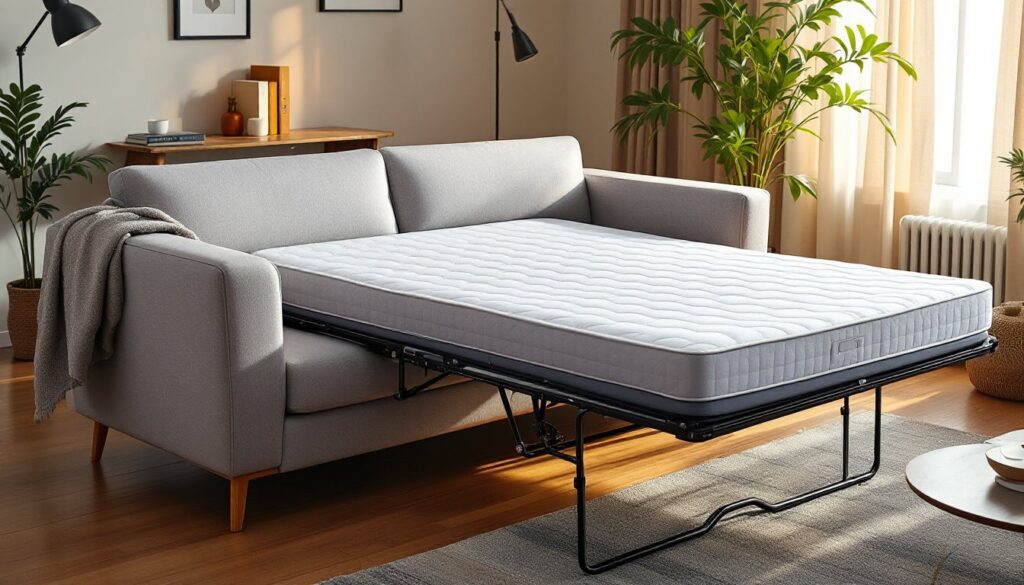
Pull-out mechanisms use a metal or wood frame tucked beneath the seat cushions. Pulling a handle or strap extends the frame forward, unfolding a mattress that rests on the floor or low supports. Modern frames use steel tube construction with reinforced corners and center support bars to handle 500–700 pounds of distributed weight.
Fold-out and click-clack designs pivot the backrest down to create a flat sleep surface. The frame locks into multiple positions, upright for sitting, reclined for lounging, flat for sleeping. Some models include a ratcheting hinge that clicks into notches for angle adjustment.
Futon-style sleepers rely on a bi-fold or tri-fold mattress that sits atop a wood or metal deck. Lowering the backrest stretches the mattress into a twin, full, or queen-size bed. The deck usually mounts to the frame with slat supports spaced 2–3 inches apart for ventilation and flex.
All convertible mechanisms share a few critical design elements: locking hinges or latches to prevent accidental collapse, reinforced joints at stress points, and mattress support that distributes load evenly. Cheaper units skimp on center support, causing sagging and squeaking within months.
Key Benefits of Adding a Convertible Sofa Sleeper to Your Home
Space efficiency tops the list. A queen-size sofa sleeper occupies roughly 32 square feet when closed, half the footprint of a guest bed plus nightstands. That frees up room for desks, storage, or play areas in multipurpose spaces.
Cost savings add up quickly. Furnishing a guest room with a bed frame, mattress, and linens runs $800–$1,500. A mid-range convertible sleeper costs $600–$1,200 and doubles as daily seating, eliminating the need for separate furniture.
Flexibility matters in homes that shift roles seasonally. Home offices become guest rooms over holidays: playrooms convert to teen hangouts. A sleeper sofa adapts without requiring furniture swaps or storage.
Improved comfort has made modern sleepers viable for regular use. Memory foam and pocket-coil mattresses (individually wrapped springs) replace the thin, bar-ridden mattresses of older models. Many now offer 5–6 inches of cushioning with quilted toppers, comparable to budget standalone mattresses.
Resale and rental appeal can’t be ignored. Listings that highlight functional guest sleeping arrangements attract more interest, especially in urban markets where square footage commands a premium. A well-maintained sleeper sofa signals thoughtful space planning to prospective buyers or tenants.
Types of Convertible Sofa Sleepers to Consider
Pull-Out and Fold-Out Mechanisms
Pull-out sleepers remain the most common in full-size and queen configurations. The mattress folds in thirds, tucking into a cavity beneath the seat cushions. Pulling the frame forward extends it 60–70 inches from the wall, so measure clearance before buying.
Look for hardwood frames (kiln-dried oak, maple, or engineered hardwood) over particleboard. Hardwood resists warping and holds fasteners better under repeated stress. The mattress platform should include a center support leg or bar, without it, the middle sags under body weight.
Modern pull-outs use air-dream or gel-infused memory foam mattresses rated at 4.5–6 inches thick. Thicker mattresses (8+ inches) often won’t fold properly, so manufacturers balance comfort with compactness.
Fold-out sleepers (also called loveseat sleepers) work best in tight spaces like studio apartments and small bedrooms. The backrest folds down to meet the seat, creating a twin or full-size bed. Total depth when open: 50–60 inches, versus 70–80 for pull-outs.
Some fold-out models include storage compartments beneath the seat, useful for stashing sheets, pillows, or extra blankets. Check the hinge mechanism: piano hinges (continuous metal hinges) distribute stress better than multiple discrete hinges.
Click-Clack and Futon Styles
Click-clack sleepers use a ratcheting backrest that locks into three or more positions. Pushing the backrest down until it clicks flat transforms the sofa into a bed. No pulling, no unfolding, just release the latch and recline.
These work well for kids’ rooms or basements where guests are occasional. The sleeping surface is firm and flat, since it’s essentially the seat and back cushions laid horizontal. Comfort depends heavily on cushion thickness and foam density. Look for high-density polyurethane foam (1.8+ pounds per cubic foot) to avoid bottoming out.
Click-clacks typically rest on metal legs or a sled base. Avoid models with thin tubular legs (less than 1-inch diameter), they bend under repeated weight and create wobble.
Futon-style sleepers appeal to DIYers who want simple mechanics and easy repair. The frame is usually solid hardwood or welded steel tubing, with a bi-fold or tri-fold mattress resting on wooden slats.
Futon mattresses range from 6 to 10 inches thick and use cotton batting, foam, or innerspring cores. Cotton futons require regular flipping and tend to compress: foam and hybrid models hold shape longer. Slat spacing matters, gaps wider than 3 inches cause mattresses to sag between supports.
Many futon frames accept standard full or queen mattresses, making replacements easy. For a DIY project with customizable dimensions, consider building a simple futon frame from 2×4 and 2×6 lumber with mortise-and-tenon or pocket-screw joinery.
How to Choose the Right Convertible Sofa Sleeper for Your Space
Start with clearance measurements. Measure the room’s depth from the wall to any obstacles (coffee tables, rugs, doorways). Add 6 inches to the manufacturer’s listed bed depth to account for cushion overhang and user movement. A queen pull-out typically needs 90–100 inches of clear floor space when fully extended.
Doorway and stairwell access trips up many buyers. Measure door widths, hallway turns, and stairwell landings. Most sleeper sofas ship fully assembled: if your door is narrower than 32 inches, look for modular designs with removable legs and backs.
Frame construction determines longevity. Flip the sofa over (in the showroom or via product photos) and inspect the underside. Corner blocks (triangular braces screwed and glued into each corner) prevent racking. Eight-way hand-tied springs or sinuous (S-shaped) wire springs stapled to the frame provide better support than elastic webbing.
For pull-out mechanisms, check the mattress support bars. There should be at least three cross-bars on a queen-size frame, spaced evenly. Frames with only perimeter support will sag.
Upholstery and fabric choice affects maintenance. Performance fabrics (polyester blends treated with stain repellents like Crypton or Sunbrella) resist spills and wear. Avoid delicate materials like linen or velvet in high-traffic guest rooms.
Cushion fill impacts daily comfort. High-resilience foam (HR foam, 2.0+ lb/ft³ density) bounces back after compression. Down-blend cushions feel softer but require daily fluffing and lose shape over time.
Weight capacity matters if the sleeper will see nightly use. Check the manufacturer’s rating, most consumer-grade sleepers handle 250–300 pounds per person. Commercial-grade units (often sold to hotels) support 400+ pounds per person but cost significantly more.
For those comfortable with home woodworking and furniture assembly, building a custom sleeper platform with a store-bought mechanism is feasible. Replacement sleeper hardware kits (frame, mattress, and hinges) are available from specialty suppliers and run $300–$600 depending on size.
Installation and Setup Tips for DIY Homeowners
Most convertible sleepers arrive fully assembled or require only leg attachment. You’ll need a Phillips screwdriver or cordless drill with a #2 bit, and possibly an Allen wrench (often included). Budget 15–30 minutes for basic assembly.
Unboxing and placement:
- Clear a space twice the sofa’s footprint to maneuver during unpacking.
- Cut away packaging carefully, avoid slicing into upholstery. Use a utility knife with a retractable blade.
- Attach legs by threading hanger bolts (bolt on one end, wood screw on the other) into pre-drilled holes in the frame. Hand-tighten, then snug with a wrench or pliers. Over-tightening can strip threads in softer woods.
- If the sleeper includes a center support leg, confirm it deploys automatically when the frame extends. Test it unloaded before adding the mattress.
Leveling and floor protection:
Place felt pads or furniture coasters under legs to prevent scratching hardwood or tile. On carpet, wide coasters distribute weight and prevent indentations.
If the floor is uneven (common in older homes), use adhesive-backed felt shims (1/16″ to 1/8″ thick) under individual legs to eliminate wobble. Test the sofa in both sitting and sleeping positions, sometimes frames sit level but tip slightly when extended.
Testing the mechanism:
- With the sofa in place, pull out or unfold the sleeper fully. Check that the frame locks securely and the mattress lies flat.
- Press down firmly on each corner and the center. Listen for creaks, squeaks, or metal-on-metal contact, signs of misaligned supports or loose fasteners.
- Fold or retract the mechanism slowly. It should glide smoothly without binding. If resistance occurs, inspect for obstructions (packaging material, tags, or misaligned fabric).
Mattress care:
Most sleeper mattresses are non-removable and fold with the frame. Protect them with a fitted waterproof mattress protector to guard against spills and allergens. Look for protectors designed for sleeper sofas, they accommodate the fold without bunching.
Rotate the mattress every 3–6 months if the design allows (some are sewn to the frame). This evens out wear and extends lifespan.
Ongoing maintenance:
- Vacuum upholstery monthly using an upholstery attachment to remove dust and debris.
- Lubricate pull-out mechanisms annually with dry silicone spray (not oil-based lubricants, which attract dust). Spray hinges, slide rails, and locking pins.
- Tighten leg bolts and frame fasteners every 6–12 months. Repeated use loosens connections over time.
- Inspect the center support leg for wear. If it’s rubber-tipped, replace the tip when it compresses or cracks.
Safety notes:
Always clear the floor before deploying the sleeper. Kids, pets, and objects can be pinched by extending frames. If you have toddlers, store the pull handle or strap out of reach to prevent accidental deployment.
Pull-out mechanisms can shift during use if the sofa isn’t against a wall. Use wall anchors or L-brackets to secure the frame to studs if the sleeper will be free-standing. This is especially important in earthquake-prone regions or homes with active children.
When the sleeper is in bed mode, ensure the center support leg contacts the floor fully. Uneven floors can leave the leg dangling, transferring all weight to the frame edges and causing premature failure.